Electrical Engineering
Consulting

Independent technical advice for complex electrical decisions.

Practical reviews, defined scope and documented recommendations.
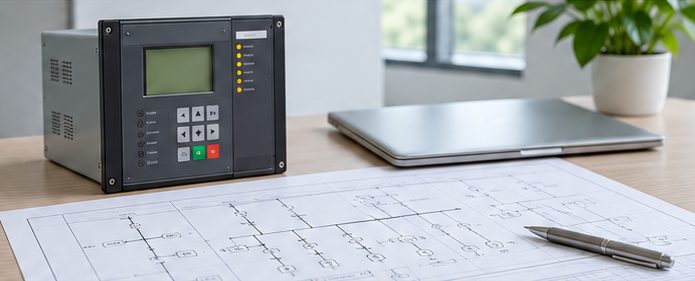
Engineering review desk with a protection relay, laptop and electrical drawings

Where independent advice helps

Technical Assessments

Review system requirements, limitations and available records.

Design & Vendor Reviews

Assess engineering submissions and resolve technical questions.

Specifications & Scope

Define the requirements for studies, equipment and engineering packages.

Modernization Advice

Compare options for changing or upgrading existing installations.

Advice that supports the next decision

Understand the requirement

Clarify the objective, scope and key constraints.

Review the evidence

Evaluate relevant records, designs and assumptions.

Document recommendations

Provide clear, practical conclusions for your next step.

Typical deliverables

Technical review reports · specifications · comment registers · prioritized recommendations.

In detail: what the work covers

Independent Protection Engineering Consultancy

Sometimes what you need is not a deliverable but a second opinion from someone with no stake in the answer. We review designs, interrogate vendor submissions, and support the technical decisions that are expensive to get wrong.

What this covers

  • Design review — independent technical review of protection and automation design packages.
  • Vendor documentation review — checking that what was supplied matches what was specified.
  • Specification support — writing or reviewing the technical sections of tender documents.
  • Standards compliance — assessment against IEC, IEEE, ANSI and NFPA requirements and against your own project standards.
  • Technical dispute support — impartial assessment where parties disagree on a protection or automation question.
  • FAT and SAT support — witnessing, procedure review, and evaluation of test results.

Standards and references

Reviews are carried out against the applicable IEC, IEEE, ANSI and NFPA standards together with the project specification and grid code.

Electrical System Design

Where power system design deals with the network, electrical system design deals with the installation inside the plant: what the loads are, how they are distributed, what size everything has to be, and what the contractor builds from. This is the detailed electrical design layer, and it is where a study that looks fine on paper either works or does not.

What this covers

  • Load schedules — connected and demand load, diversity, and the growth allowance the installation is sized for.
  • Distribution design — MV and LV distribution architecture, switchboard and MCC arrangement, and essential versus non-essential segregation.
  • Cable sizing and routing — current capacity, voltage drop, short circuit withstand and derating for installation conditions.
  • Switchboard and MCC specification — form of separation, ratings, and the technical schedule issued to manufacturers.
  • Plant control schematics and wiring — schematic, wiring and termination drawings and control cubicle layout within the plant design package. Protection and control secondary circuits for relay schemes, replacements and modifications are covered by Protection & Control Schematic Development .
  • Small power, lighting and earthing — installation earthing, bonding and the LV distribution supporting them.
  • Hazardous area considerations — equipment selection and protection concepts where classified zones apply.

Standards and references

Design follows IEC 60364 for low-voltage installations, IEC 61439 for switchgear assemblies, IEC 60287 and IEC 60364-5-52 for cable sizing, IEC 61936-1 above 1 kV, and IEC 60079 where hazardous areas are involved.

We hold no distributor agreements, so the recommendation reflects what suits your network rather than what suits a supplier.

Bring us the engineering question you need to resolve.

Discuss Your Requirements