
Station Bus Architecture
Define the device relationships and communication interfaces.
Substation communication and configuration engineered across devices and interfaces.
Clear architecture, signal mapping and configuration records for the agreed system.
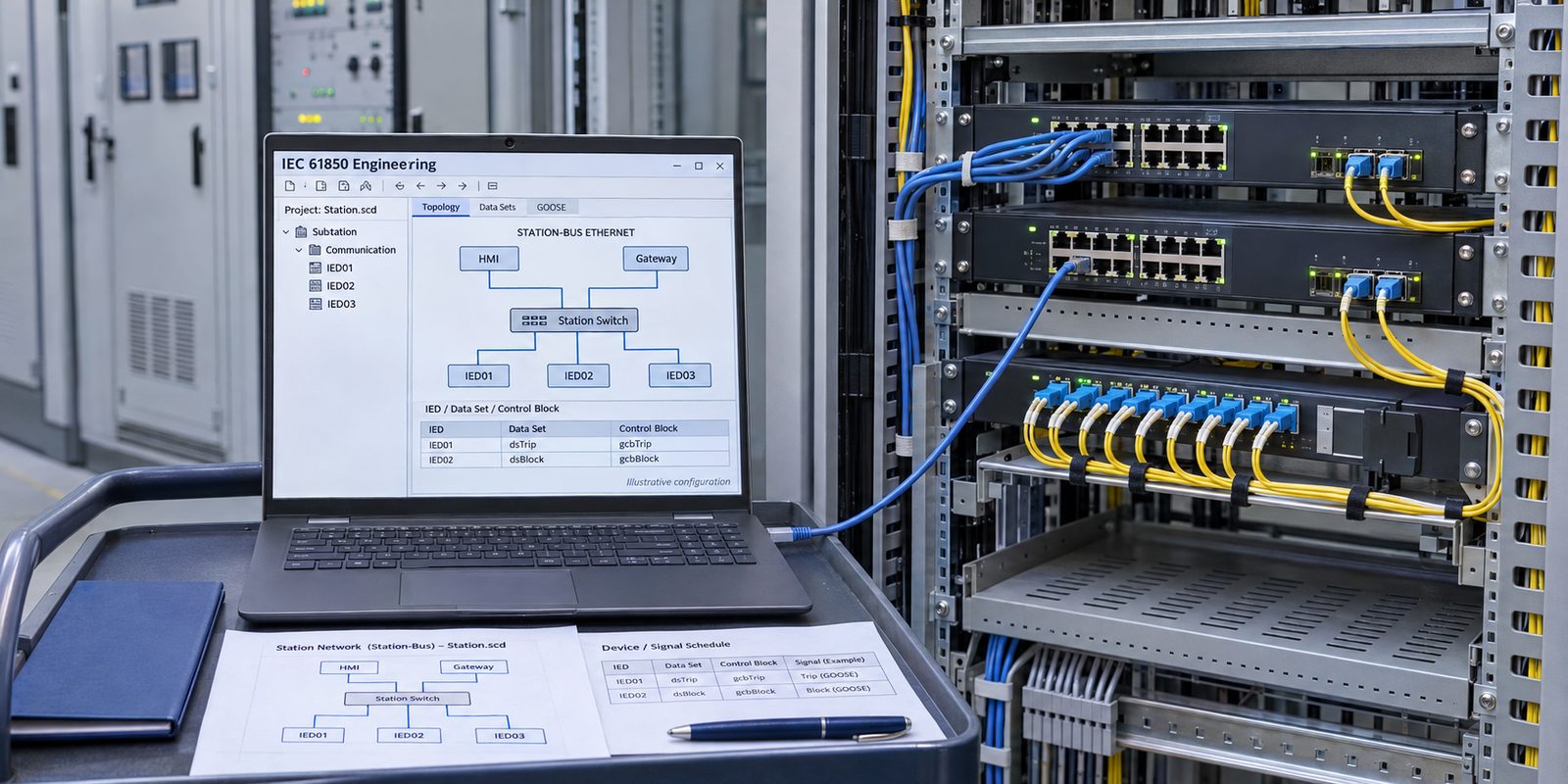
Define the device relationships and communication interfaces.
Prepare and coordinate system configuration information.
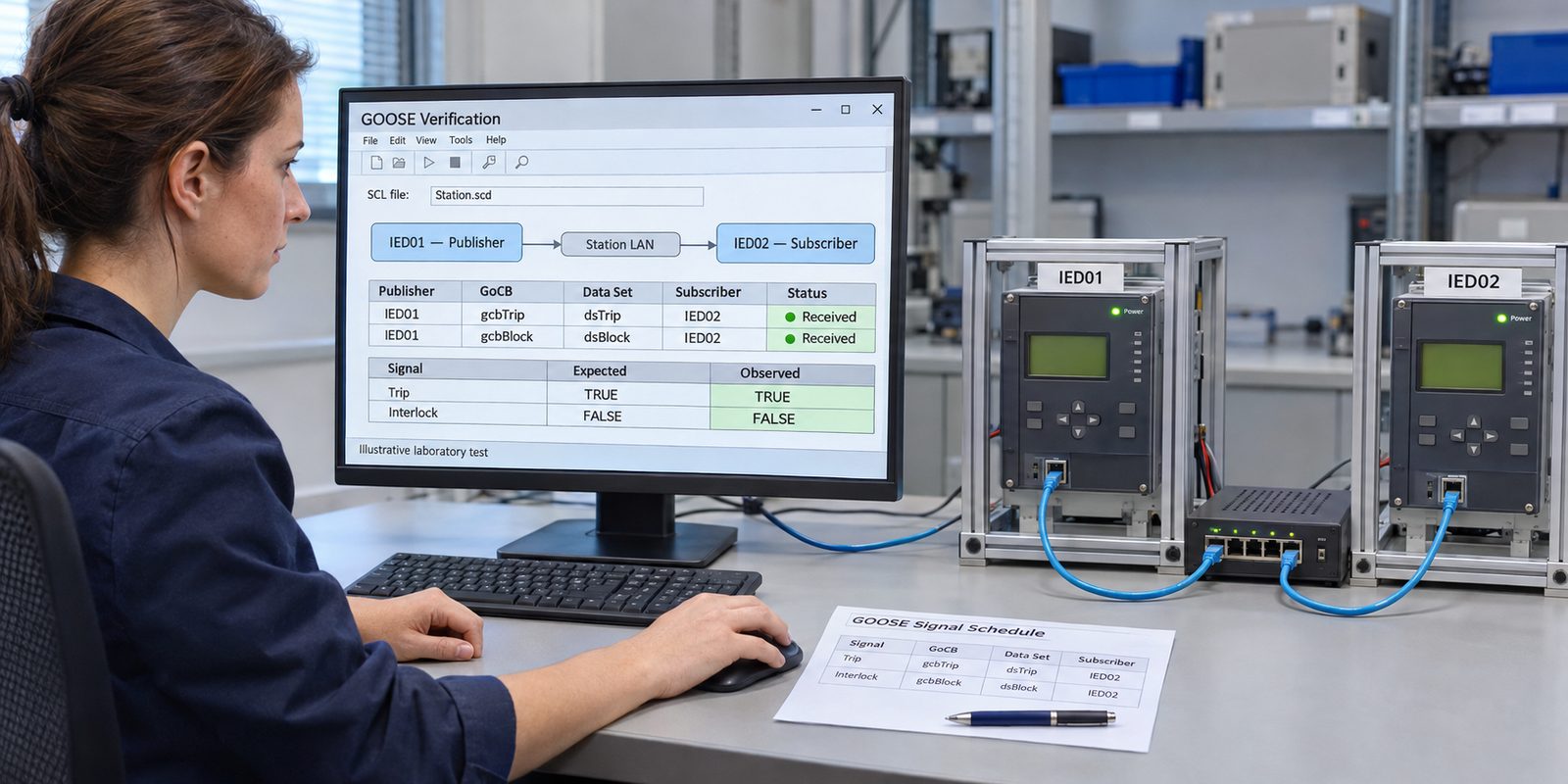
Develop message, dataset and signal relationships.
Document mapping and verification requirements.
Supported models and configuration scope are confirmed at the start.
IEC 61850 moves protection and control signalling onto a communication network. Station-bus applications such as GOOSE can replace selected hardwired signals between devices, and process-bus applications bring sampled values from merging units; which of them suits a project depends on the system architecture and scope. We engineer both new digital substations and the staged migration of running hardwired installations, planned so that protection remains in service through the transition.
Work is carried out to the IEC 61850 series — including 61850-6 for SCL, 61850-7 for the data model and 61850-8-1 and 9-2 for GOOSE and sampled values — alongside IEC 60255 for the relays themselves.
We hold no distributor agreements, so the recommendation reflects what suits your network rather than what suits a supplier.
Substation automation covers everything between the protection relays and the people operating the network: how devices communicate, how switching is interlocked, what the operator sees, and what the control centre receives. Getting it wrong shows up as nuisance alarms, unusable event records and switching that cannot be performed safely.
Engineering follows IEC 61850 for station communications, IEC 60870-5 and DNP3 for telecontrol, and IEC 61936-1 for the installation, with the network operator's own interface specification taking precedence where one exists.
We hold no distributor agreements, so the recommendation reflects what suits your network rather than what suits a supplier.