
Device & Firmware Review
Confirm platform details and the required functions.
Relay Protection
Turn agreed protection requirements into device-specific configurations.
Settings implementation, programmable logic and documented interfaces.
Confirm platform details and the required functions.
Enter the approved protection parameters into the configuration.
Develop signal assignments, logic and interlocking.
Document relevant device and system interfaces.
Testing and deployment responsibilities are defined in the scope.
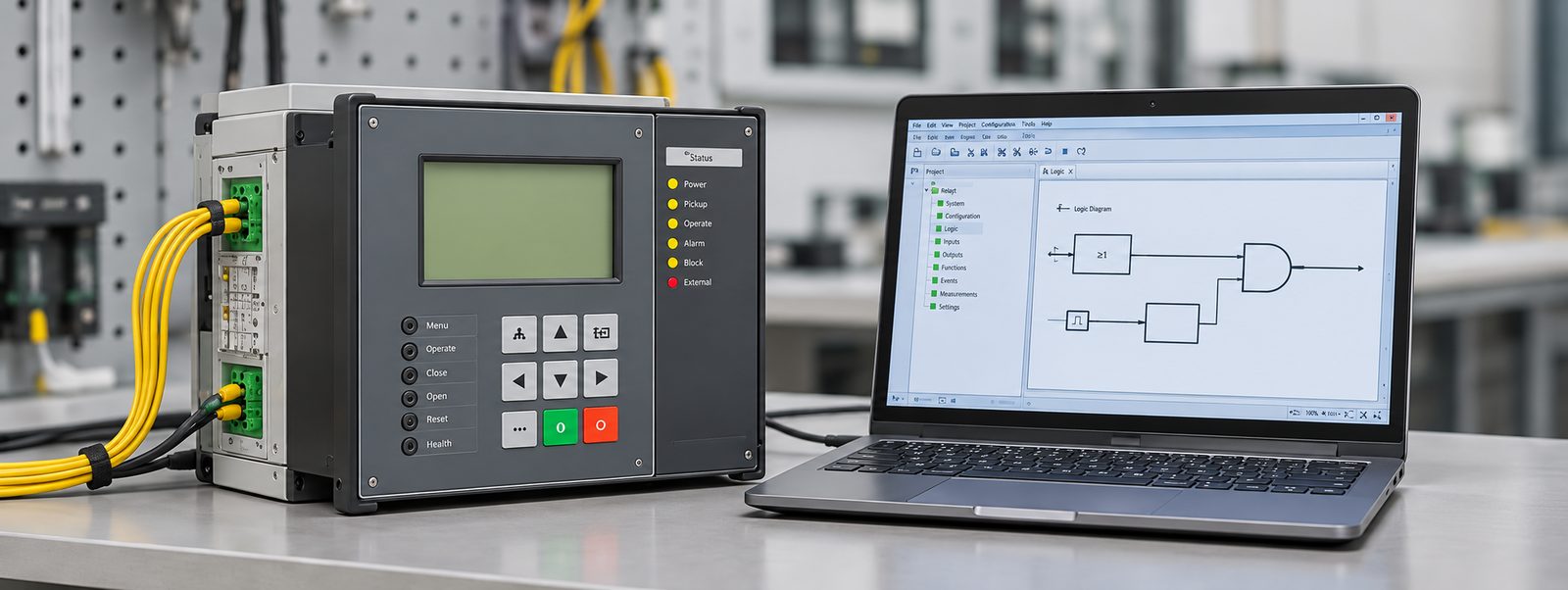
We develop and revise numerical relay configurations for new installations, existing systems and modernization projects. The work translates the agreed protection philosophy and calculated settings into a device-specific configuration, including programmable logic, signals, control functions and relevant communication interfaces.
Typical applications include feeder, transformer, generator, motor and busbar protection, in hardwired or IEC 61850 schemes.
Calculation of new settings and wider network coordination studies are included where explicitly specified; configuration work alone does not replace those studies.
Configuration and logic work references IEC 60255 for relay performance, IEC 61850 for station communications, and the applicable IEEE C37 series for scheme practice, alongside your project specification and any utility grid code that applies.
Our approach is vendor-independent, while each configuration is developed in the appropriate manufacturer's engineering environment. The relay model, firmware, available functions and required software access are confirmed before the scope is finalized.