Relay Settings &
Coordination

Calculate and document protection settings for agreed operating scenarios.

A traceable basis for reviewing sensitivity, selectivity and operating times.
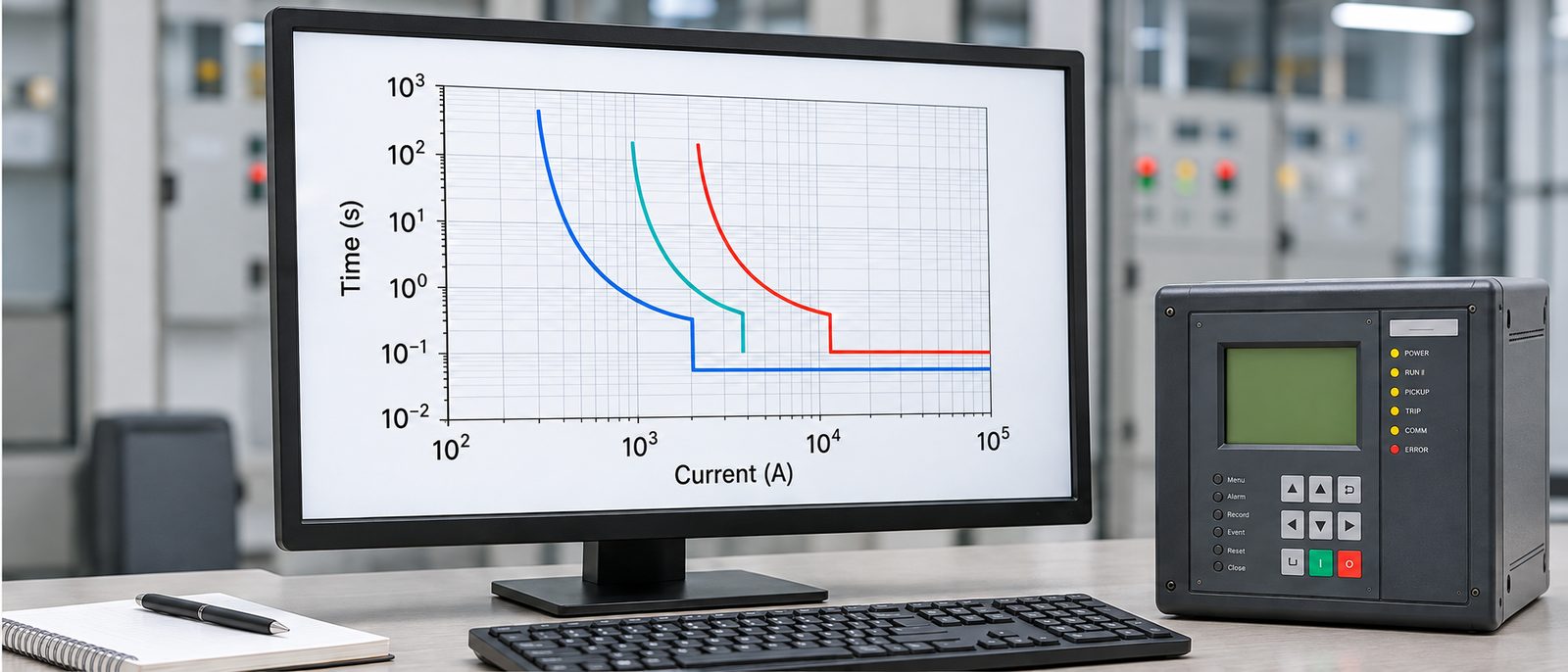
Monitor showing time-current coordination curves next to a numerical protection relay
Illustrative engineering view

Scope of the assessment

Fault Data & Scenarios

Review the network model and relevant operating conditions.

Protection Functions

Develop settings for the agreed protection requirements.

Coordination Review

Assess the relationships between protective devices.

Application Checks

Review CT/VT data and equipment constraints where required.

Typical deliverables

  • Calculation report
  • Setting schedules
  • Coordination plots
  • Assumptions and limitations

Inputs to define the scope

  • Single-line diagrams
  • Equipment and fault data
  • Relay information
  • Operating scenarios

Device configuration is scoped separately.

In detail: what the work covers

Relay Settings Calculations & Coordination

We calculate and review protection settings against equipment characteristics, fault conditions and operating scenarios. Coordination studies assess sensitivity, selectivity and operating times, with assumptions, equipment constraints and any coordination limitations documented.

What this covers

  • Overcurrent and earth fault — pickup, time multiplier and curve selection for phase and earth elements, including directional and sensitive earth fault where required.
  • Differential protection — bias characteristics, inrush and CT saturation restraint for transformers, generators, motors and busbars.
  • Distance protection — zone reach, timing and teleprotection scheme settings for transmission lines.
  • Coordination study — time-current curve plots across each protected path from source to load.
  • CT and VT verification — checking that instrument transformer ratio, class and burden actually support the settings applied.
  • Arc flash interaction — reviewing where settings drive incident energy, and where maintenance switching or zone-selective interlocking helps.

Standards and references

Calculations are prepared against IEC 60255 and the IEEE C37 series, with fault levels derived to IEC 60909 or ANSI/IEEE C37.010 depending on the project basis.

Protection Change Assessment

We assess the impact of equipment additions, changes to supply arrangements and revised network operating modes on existing protection systems. Our review evaluates settings, logic and coordination against the modified system conditions to determine whether the existing protection remains appropriate.

Typical changes

  • Addition or replacement of motors, transformers or generators.
  • Changes to incoming supplies or source capacity.
  • Bus-section and tie operating changes.
  • Network extensions and feeder modifications.
  • Changes to grounding arrangements where relevant.
  • Revised normal, emergency or islanded operating modes.

Typical inputs

  • Existing and proposed single-line diagrams.
  • Equipment ratings and relevant technical data.
  • Existing protection settings and relay configuration files, where available.
  • Protection philosophy and coordination requirements.
  • Relevant fault-level information or an available network model.
  • Existing and proposed supply arrangements and operating modes.
  • Relevant control and interface documentation.

Where essential information is missing, we identify the assumptions and further data or studies needed before recommendations can be finalized.

What we assess

  • Effects on relevant fault conditions.
  • Protection sensitivity and selectivity.
  • Operating times and coordination.
  • Setting groups and associated logic.
  • Interfaces affected by the change.
  • Requirements for further studies or configuration revisions.

Discuss your network and required protection study.

Scope Your Settings Study